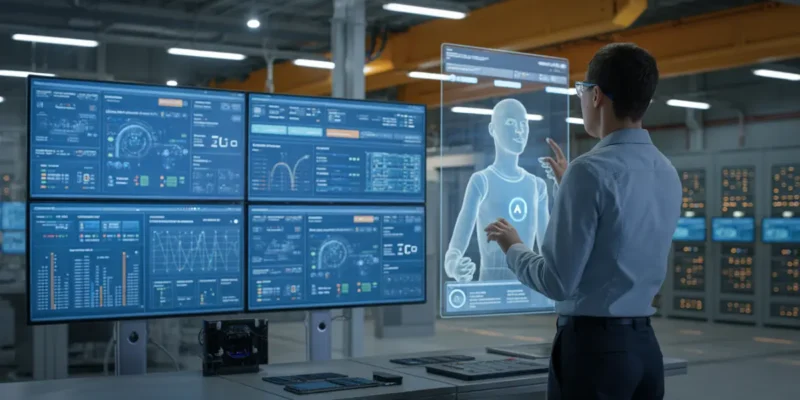
Artificial Intelligence has rapidly moved from a futuristic concept to a practical tool shaping industries across the globe. Yet within operations teams—especially in industries like energy, logistics, and manufacturing—AI often triggers a familiar concern: Will AI replace human operators?
The real answer is far less threatening and far more transformative. AI is not here to replace operators; it is here to reinforce and elevate them.
The Fear of Replacement
Whenever new technology enters the workplace, resistance is natural. From automation in factories to digital control systems in industrial plants, every technological shift has raised the same question: Will humans become obsolete?
AI has amplified this fear because of its ability to process massive amounts of data, identify patterns, and even make recommendations in real time. For operations teams that have long relied on human judgment and experience, the idea of machines “thinking” can feel unsettling.
But history shows a different pattern. Technology rarely eliminates the need for people—it changes how people contribute.
Augmentation, Not Replacement
AI works best when paired with human expertise. In operations environments, AI can analyze sensor data, predict equipment failures, and optimize workflows faster than any individual could. However, the context, decision-making, and situational awareness still come from human operators.
Think of AI as a powerful co-pilot.
Operators remain in control, but they now have tools that provide deeper insights, faster diagnostics, and predictive intelligence. Instead of replacing operators, AI augments their capabilities, allowing them to move from reactive problem-solving to proactive optimization.
The Evolution of Skills
As AI enters operations, the role of the operator evolves. Traditional responsibilities focused heavily on monitoring systems, responding to alarms, and managing manual interventions.
With AI assistance, operators shift toward higher-value activities such as:
- Interpreting AI-driven insights
- Making strategic operational decisions
- Optimizing performance and efficiency
- Managing complex systems with predictive intelligence
In other words, operators move from monitoring machines to managing intelligent systems.
This transformation is not about fewer jobs—it’s about smarter roles.
A Powerful Perspective from Jensen Huang
NVIDIA CEO Jensen Huang captured this shift perfectly when he said:
“AI may not take your job, but the person who learns AI will.”
This quote highlights the real challenge facing today’s workforce. The risk is not AI itself—it’s failing to adapt to it.
The professionals who learn how to work with AI will become more valuable, more efficient, and more influential within their organizations.
What This Means for the Houston Workforce
Houston sits at the center of the global energy and industrial operations ecosystem. Thousands of engineers, operators, and technicians manage complex facilities every day—from refineries to offshore platforms.
As AI becomes embedded in operational systems, the Houston workforce has an opportunity to lead this transformation.
Instead of resisting AI, operators and engineers who embrace it will gain:
- Better predictive maintenance capabilities
- Enhanced operational visibility
- Improved safety insights
- Greater efficiency in large-scale operations
This is not about replacing expertise. It is about amplifying it.
The Real Future of Operations
The future of operations will not be fully automated plants run by machines alone. Instead, it will be human-AI collaboration.
AI will process the data.
Humans will provide the judgment.
Together, they will run smarter, safer, and more efficient operations.
The question is no longer whether AI will enter operations—it already has. The real question is whether organizations and professionals will learn to harness its power.
Because in the end, AI doesn’t remove operators.
It elevates operators.