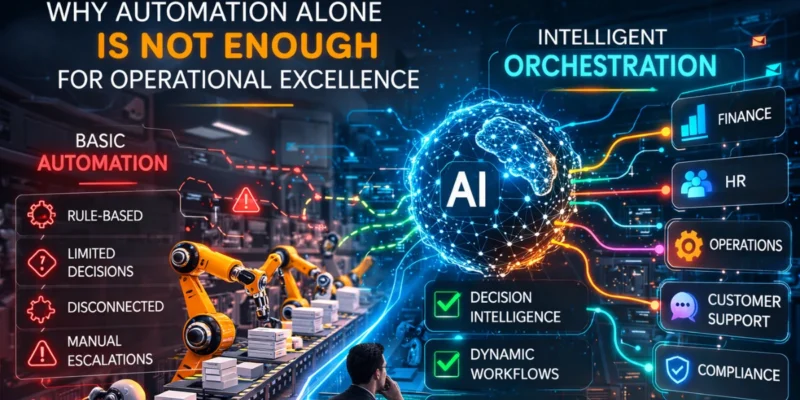
Over the past decade, automation has become the poster child of operational transformation. Companies across industries have invested heavily in Robotic Process Automation (RPA), workflow tools, and scripted systems to eliminate repetitive work. And to be fair, automation has delivered real benefits. Processes that once took hours now take minutes. Teams that once handled thousands of manual entries can now focus on higher-value work.
But here’s the uncomfortable truth many organizations are beginning to realize:
Automation alone does not create operational excellence.
It creates speed. Not intelligence.
The Automation Plateau
Most organizations adopt automation with a simple objective — remove manual effort from repetitive processes. Invoice processing, data entry, document handling, onboarding workflows — these are perfect candidates for automation.
And initially, the results are impressive.
Processing time drops. Error rates decline. Operational costs shrink. Leadership celebrates the success of digital transformation.
But after this first wave of automation, something interesting happens.
Progress slows down.
Processes become faster, but they do not become smarter.
Automation follows predefined rules. It executes instructions exactly as designed. But the moment a process requires judgment, interpretation, or dynamic decision-making, traditional automation begins to struggle.
The Real Problem: Decision Complexity
Modern operations are no longer simple, linear workflows.
A single operational process may involve:
- Multiple systems
- Different data formats
- Exceptions and edge cases
- Human approvals
- Compliance rules
- Real-time business priorities
In such environments, the challenge is not just executing tasks faster — it is deciding what should happen next.
Consider a simple example.
An automated system may process a customer request quickly. But what happens when:
- The data is incomplete?
- The request violates a policy rule?
- Multiple teams must collaborate?
- A priority customer requires escalation?
Traditional automation pauses. It waits. It escalates. It breaks the flow.
This is where many RPA-driven organizations hit a ceiling.
They automated tasks, but they did not orchestrate decisions.
Speed Without Coordination
Another common issue with automation-first strategies is fragmentation.
Different departments automate their own workflows:
- Finance automates invoices
- HR automates onboarding
- Operations automates order processing
- Customer support automates ticket routing
Individually, these automations work well.
Collectively, they often create disconnected islands of efficiency.
Data gets stuck between systems. Exceptions bounce between teams. Processes require manual coordination.
Ironically, the more automation organizations deploy, the more complex the operational landscape can become.
The Next Step: Intelligent Orchestration
If automation was the first step toward operational excellence, the next step is intelligent orchestration.
Intelligent orchestration goes beyond executing tasks. It focuses on coordinating processes, systems, data, and decisions across the organization.
Instead of asking:
“Can this task be automated?”
Leading organizations now ask:
“How should this entire process be orchestrated?”
Intelligent orchestration introduces several new capabilities:
1. Decision-Aware Processes
Processes can evaluate data, context, and business rules before choosing the next action.
2. Dynamic Workflows
Instead of rigid rule-based paths, workflows adapt to real-time conditions.
3. Human + AI Collaboration
Not every decision should be automated. Intelligent orchestration routes tasks to the right mix of AI systems and human expertise.
4. End-to-End Visibility
Organizations gain a unified view of how processes flow across departments, systems, and teams.
The result is not just faster operations — but more resilient, adaptive operations.
Automation Is a Tool, Not the Strategy
Automation remains incredibly valuable. It removes friction, reduces manual work, and improves operational speed.
But operational excellence requires more than just speed.
It requires coordination, intelligence, and the ability to handle complexity.
Organizations that stop at automation will eventually reach diminishing returns.
Organizations that move toward intelligent orchestration will unlock the next level of performance — where processes are not only automated, but also aware, adaptive, and aligned with business outcomes.
In the coming years, the companies that lead operational transformation will not be the ones who automated the most tasks.
They will be the ones who orchestrated their operations intelligently.