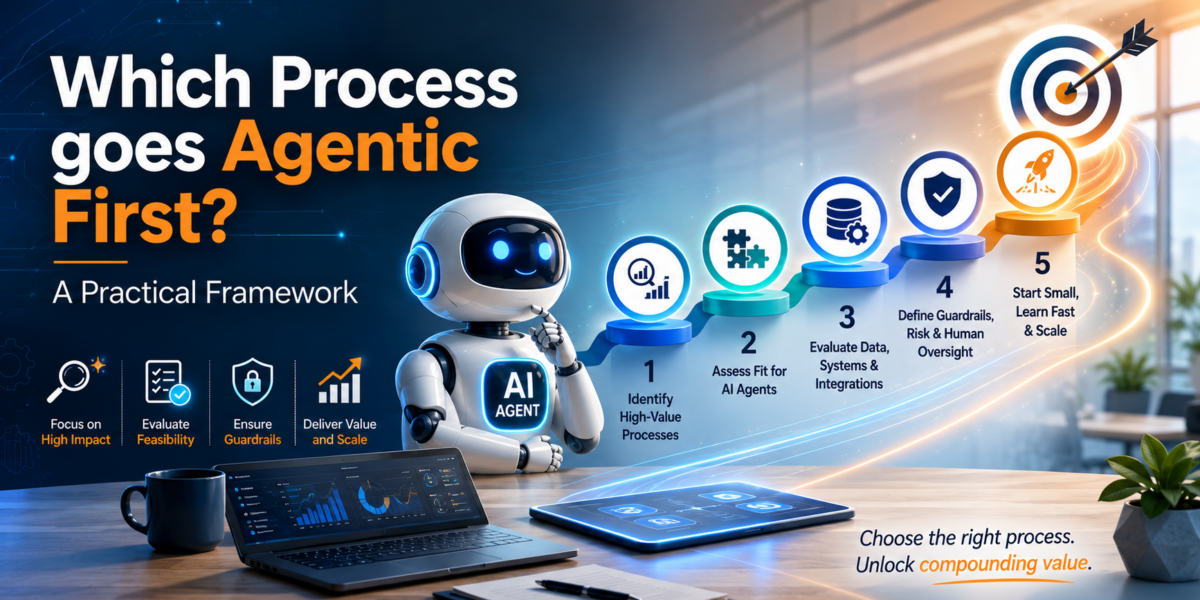
Every major enterprise platform has declared AI agents as core infrastructure. The question is no longer whether to agentize your operations — it’s where to start. Here’s a practical set of questions to help you decide.
June 2026 has produced a striking consensus across the enterprise technology landscape. AWS, Google Cloud, IBM, Microsoft, Databricks, and BCG have all framed AI agents as a new foundational software layer — not a future capability, but a present reality that organizations need to be building toward now.
For most organizations, that raises an immediate and practical question: where do we start? Which process, which team, which workflow is the right first candidate for agentic AI — and how do we make that decision confidently rather than reactively?
Not every process is ready. Not every process is worth it.
One of the most common mistakes we see in enterprise AI is treating agentization as a universal upgrade — something to roll out broadly across operations because the technology is now available. The reality is more nuanced. Some processes are strong candidates for agentic AI right now. Some need minor gaps filled before agents can operate reliably in them. And some genuinely aren’t ready — because the ROI doesn’t justify the investment yet, the risk is too high, or the process itself is too structurally undefined to automate intelligently.
The framework below isn’t a scoring model. It’s a set of reflective questions — across three dimensions — that help leadership teams have an honest conversation about any process they’re considering for agentic implementation. Work through them together. The answers will tell you which bucket the process belongs in.
The Three Dimensions
Dimension 01 — Process Readiness
Q1 – Is this process repeatable — does it follow a consistent pattern most of the time, even if exceptions exist?
Q2 – Is the process well enough understood that you could explain every step, decision point, and exception path to someone new — or do significant gaps exist in how it’s documented versus how it actually runs?
Q3 – Does the process cross multiple systems or teams — and if so, are those handoffs clearly defined, or do they rely on informal coordination that isn’t captured anywhere?
Dimension 02 — Value Potential
Q4 – Does this process consume significant time, create bottlenecks, or directly impact revenue, customer experience, or compliance outcomes?
Q5 – Would running this process faster, more consistently, or continuously — without requiring human initiation at every step — create meaningful, measurable business value?
Q6 – Is this process a constraint on growth — something your organization would do more of, or do better, if it required less human effort to run?
Dimension 03 — Risk & Governance
Q7 – Can you clearly define what an agent should decide autonomously versus what always requires human review or approval — and are those boundaries ones your legal, compliance, and operations teams would be comfortable with?
Q8 – If the agent makes a mistake in this process, is the impact recoverable — or are the consequences severe enough that extensive governance infrastructure needs to be in place before any autonomous action is appropriate?
Where does your process land?
✓ Ready for Agentic Transformation
The process is repeatable and well understood, the value is clear, and the governance boundaries are definable. This is a strong candidate for agentic implementation through the ACE Method™. The goal isn’t a one-time deployment — it’s progressive autonomy, with agents taking on more of the routine orchestration over time while humans stay in the loop at the moments that genuinely require judgment.
◑ Agentic Transformation after Process Improvement (Step 0)
The process has the right value and governance profile, but gaps exist in how it’s documented, how handoffs work, or how exceptions are handled. Step 0 in ACE isn’t a major process overhaul — it’s crack-filling. Forward Deploy Engineers embed alongside the team, surface what’s missing, and close those gaps as the natural starting point of the engagement. ACE then builds on a solid foundation rather than an idealized one.
✗ Not yet for Transformation
The process lands here for one of three reasons: the ROI doesn’t justify the investment at this stage and there are higher-value processes to agentize first; the risk of agent error is too high without more governance infrastructure in place; or the process is too structurally undefined to automate intelligently. Not yet isn’t a permanent verdict — it’s an honest prioritization. Come back to these once the higher-value, lower-risk processes have been addressed.
A note on ACE as a continuous journey
The ACE Method™ (Adaptive Capability Engineering) isn’t a one-time implementation. It’s a structured approach to progressively embedding intelligence, governance, and adaptability into business processes over time. The first deployment is the starting point, not the destination. Each iteration makes the process smarter, more autonomous, and better calibrated to the realities of how the business actually operates — with humans staying in the loop at the decisions that matter most.
This is why the qualifying framework above matters. The processes you start with set the foundation for everything that follows. Starting with a strong candidate — or with a candidate that Step 0 can quickly prepare — means your first ACE engagement delivers visible, measurable results that build the organizational confidence to move to the next process, and the next.
Ready to run this framework against your own processes?
Our Forward Deploy Engineers work on-site with your team to run exactly this kind of process evaluation — surfacing the strongest candidates, identifying what Step 0 looks like for each one, and building the roadmap for your ACE engagement. End-to-end, from discovery through deployment.
Click here to book a free strategy consultation
📝 Note: This article was drafted by Claude based on research direction, editorial inputs, and perspectives provided by the author.