THE VENDOR LOCK-IN THAT NO ONE’S TALKING ABOUT
Enterprises are adopting AI faster than they’re understanding what it actually costs to own it. That gap is becoming a problem.
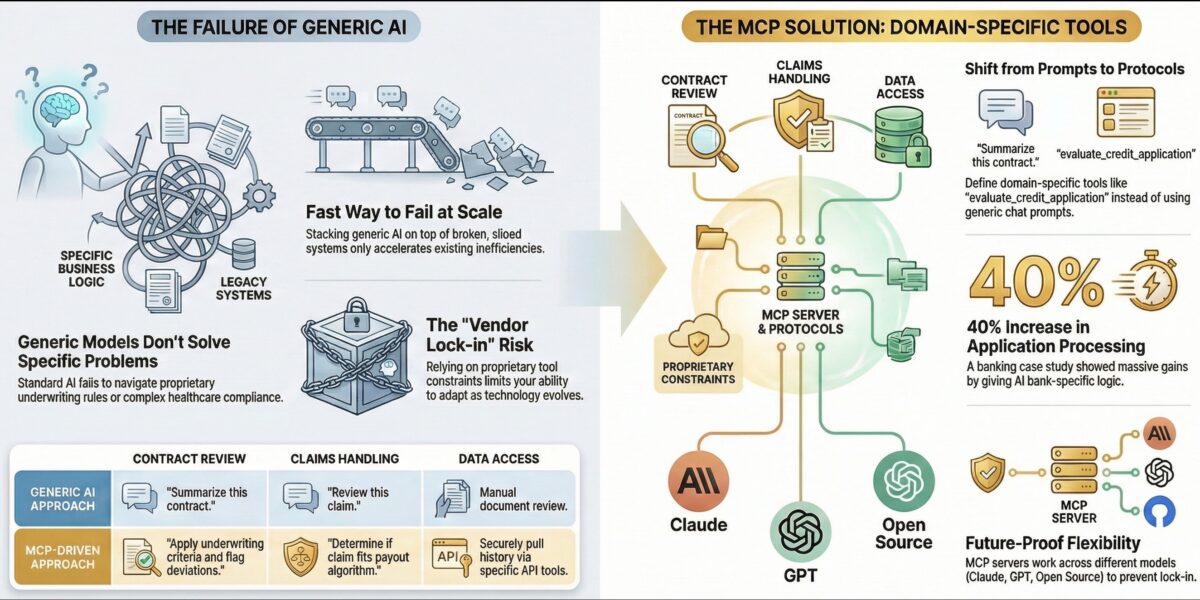
The move from proof-of-concept to production has exposed something most organizations didn’t anticipate: generic AI models don’t solve business problems. They just expose them. Your compliance workflows remain broken. Your document processes still demand manual review. Your data sits in silos.
Stack a generic AI on top of a broken system, and you get a fast way to fail at scale.
This is why the smartest enterprises we’re working with aren’t asking “Which AI platform should we buy?” anymore. They’re asking something harder: “How do we build AI that actually understands our business logic?”
The answer isn’t in the model. It’s in the protocol.
WHAT’S ACTUALLY HAPPENING
Most enterprises approach AI the way they approach software: you buy a tool, configure it, deploy it. This assumes your business fits the tool’s constraints. But your business isn’t generic. Your insurance underwriting rules differ from your competitor’s. Your healthcare compliance workflows carry regulatory weight no off-the-shelf system can navigate. Your document templates aren’t just formatting. They’re institutional knowledge encoded in a specific layout.
The Model Context Protocol represents a fundamental shift in how this should work.
Instead of forcing your workflows into a tool’s constraints, MCP lets you define domain-specific tools that speak your business language. Not generic capabilities. Not “find and replace text.” But actual business functions: update_underwriting_decision. fetch_patient_records_with_compliance_check. generate_regulatory_filing.
Let me show you what this actually means in two industries where we’ve built this.
A bank spent months trying to use generic Claude for loan underwriting. The model could suggest reasonable decisions. It couldn’t encode the bank’s proprietary risk models. It couldn’t interface with their legacy credit systems. It couldn’t generate the audit trail regulators required.
We built a custom MCP server. Same Claude model underneath. But now it exposed bank-specific tools. Evaluate_credit_application. Retrieve_compliance_history. Generate_underwriting_memo. The underwriting team now processes 40% more applications with higher consistency. Not by replacing anyone. By giving them a teammate that understands the bank’s specific logic.
In healthcare, it looked similar. A health system needed to automate patient intake and triage. Off-the-shelf AI chatbots couldn’t access their EHR. Couldn’t understand their referral workflows. Couldn’t handle HIPAA requirements. Custom MCP server. Domain-specific tools. Now intake specialists have an AI teammate that pulls patient history securely, flags edge cases that need human judgment.
Same pattern across both. Same outcome: domain-specific tools transform the entire picture.
WHAT THIS ACTUALLY REQUIRES
MCP isn’t a silver bullet. Building domain-specific AI means understanding your own systems deeply. A lot of organizations can’t or won’t do that without help. It demands governance too. What can your AI access? Where does it need human approval? What happens when it makes a mistake?
There’s also something worth mentioning about vendors. When you build custom MCP servers, you’re not locked into any single AI provider. Claude, GPT, open-source models, whatever comes next. They all work with the same protocol. That flexibility matters more than most organizations realize.
But flexibility comes with responsibility. You’re maintaining that layer. That isn’t trivial.
The real risk isn’t MCP itself. It’s misunderstanding what it solves. MCP won’t fix a broken process. It will only make a broken process faster. You need to know which processes are actually fixable with AI and which need structural change first.
WHERE TO START
You don’t need a perfect understanding of MCP to start thinking differently about AI. Here’s where we’re seeing early-stage success:
Look at your actual workflows. Find one high-value, repeatable process. Claims processing. Document review. Intake workflows. Ask yourself: What business logic does this encode? What systems does it touch? Could that logic be made explicit as a tool?
Stop writing generic prompts. Instead of “summarize this contract,” try “apply our underwriting criteria to this contract and flag deviations.” Instead of “review this claim,” ask “determine if this claim fits our payout algorithm and surface exceptions.” The specificity is where leverage lives.
Build governance into your design from day one. Before your AI touches sensitive systems, know exactly what it can read, what it can write, where it needs human approval. Treat access control for AI the same way you would for a new employee on their first day.
OUR PERSPECTIVE
We don’t build generic AI solutions. We build AI that understands your business. And that almost always means building custom MCP servers that speak your language.
What we’re seeing right now is a widening gap. Enterprises with the discipline to understand their own workflows are moving faster with AI. Enterprises treating AI as a plug-and-play purchase are building expensive pilots that don’t scale.
MCP is powerful. But there’s a lack of understanding in the market about what it actually enables and what it requires. The organizations that will capture the most value in the next 18 months aren’t waiting for the perfect AI product. They’re building the system that fits their business.
If you’re thinking through AI strategy right now, whether you’re moving from pilot to production or trying to understand why your first deployment didn’t land as expected, the conversation is worth having. We can walk through what domain-specific AI could mean for your organization.




EichaelTog
Keep this going please, great job!
Big Bass Bonanza 3 Reeler
LewisLek
Good post but I was wanting to know if you could write a litte more on this topic? I’d be very thankful if you could elaborate a little bit further. Kudos!
online casino ohne oasis schnelle auszahlung